
Computational Design & Engineering: Five Capabilities for Complex Projects

From design intent to engineered, optimized and fabrication-ready solutions — connecting geometry, algorithms, data and technical delivery.
"Thiết kế tính toán và kỹ thuật: năm nhóm năng lực kết nối ý tưởng thiết kế với triển khai kỹ thuật và sản xuất."

Complex projects rarely fail because of geometry alone. The real challenge is coordinating design intent with performance criteria, technical constraints, documentation and fabrication. As projects become more complex, disconnected workflows can create repetitive work, inconsistent data and costly coordination gaps.
ATTRACTOR approaches these challenges through Parametric Design, Computational Methods and AI-driven workflows. Rather than treating each tool as an isolated solution, the aim is to connect design exploration, engineering logic and project delivery in a coherent process.
This article outlines five connected capabilities for architecture and engineering teams. Each can address a specific project need, while also forming part of a broader computational workflow.
In this article
01. Computational Architecture & Design

Architectural concepts involving non-standard geometry, repeated systems or multiple design variables can be difficult to develop through manual modeling alone. Parametric and computational methods make relationships explicit, allowing teams to explore alternatives while retaining control over key constraints.
Depending on the project scope, this capability can support:
Parametric architectural and spatial concepts.
Generative geometry and controlled design variations.
Rule-based systems for interiors, landscape or building components.
Design studies that compare alternatives against defined criteria.
The objective is not complexity for its own sake. It is to make complex design intent easier to test, coordinate and develop into a technically informed proposal.
"Ứng dụng: phát triển kiến trúc, không gian và hình thái sinh hình; kiểm soát biến thể thiết kế bằng hệ tham số."
02. Facade Engineering & Digital Delivery
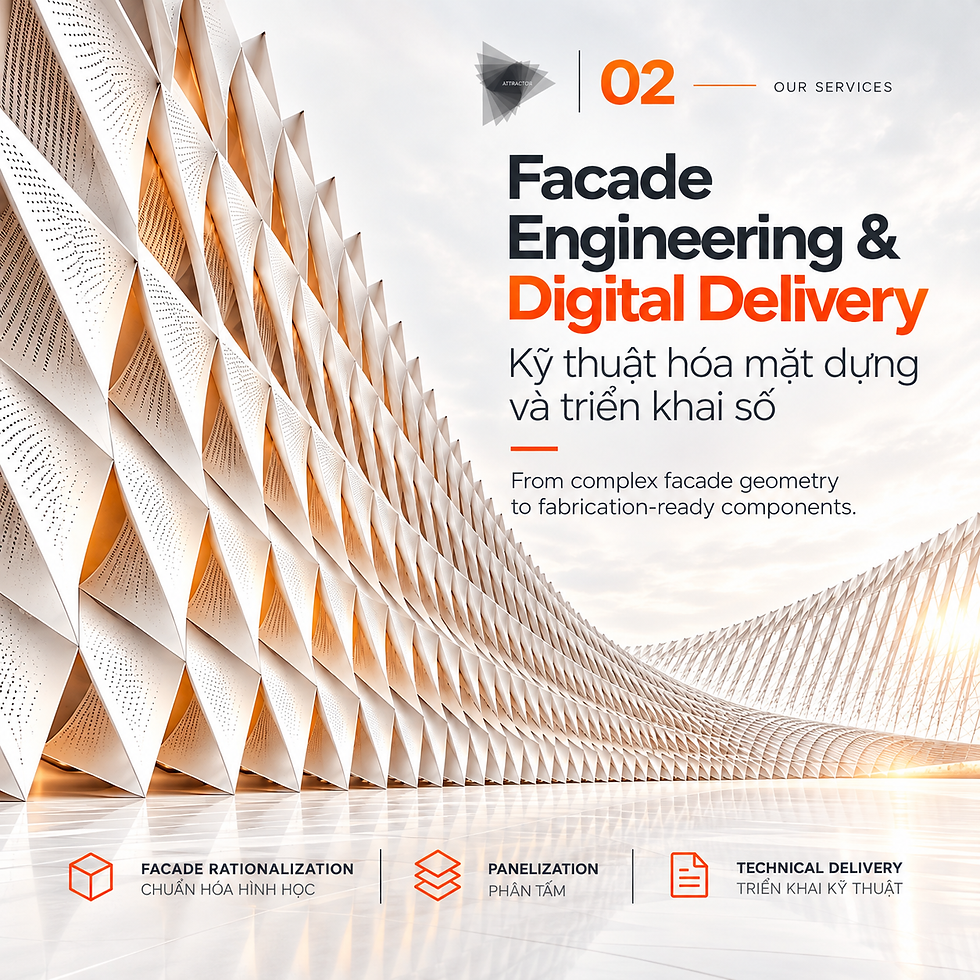
Complex facade geometry introduces a chain of linked tasks: rationalization, panelization, component identification, dimensional control and documentation. If these tasks are handled separately, changes to the design can trigger extensive rework.
A computational workflow can help teams:
Rationalize and organize complex facade geometry.
Develop panelization logic and component variations.
Generate component identifiers and schedules.
Prepare coordinated geometric and technical data for downstream delivery.
Project-specific engineering review remains essential. Connections, tolerances, material behavior, drainage, installation access and fabrication limits must be checked against the relevant design requirements.
"Ứng dụng: chuẩn hóa hình học mặt dựng, phân tấm, quản lý cấu kiện và chuẩn bị dữ liệu triển khai kỹ thuật."
03. BIM, Shop Drawings & Design Automation

Architecture and engineering teams often spend substantial effort repeating model updates, extracting schedules and coordinating technical documentation. Design automation can reduce manual repetition when the rules, data structure and deliverable requirements are clearly defined.
Depending on project requirements, workflows may include:
BIM modeling support and geometry-to-element workflows.
Shop drawing and documentation automation.
Parameter, schedule and component-data extraction.
Workflow connections between Rhino, Grasshopper and Revit, including Rhino.Inside.Revit where appropriate.
Automation does not remove the need for model validation. Element mapping, model standards, level of information, coordination rules and deliverable formats should be agreed before implementation.
"Ứng dụng: mô hình hóa BIM, hồ sơ kỹ thuật, trích xuất dữ liệu và tự động hóa các tác vụ lặp lại."
04. Environmental & Urban Performance

Design decisions influence solar exposure, daylight, shading, density and spatial performance. Computational workflows can help teams compare scenarios earlier, when design changes may still be more practical to implement.
Potential applications include building environmental simulation, solar and daylight studies, urban spatial analysis and performance comparisons across design alternatives. Tools such as Ladybug and Honeybee can support selected environmental analyses within Grasshopper-based workflows.
The usefulness of an analysis depends on reliable input data, appropriate assumptions and clear interpretation of results. Simulation should inform professional judgment, not replace it.
"Ứng dụng: mô phỏng môi trường công trình, phân tích không gian và so sánh phương án theo tiêu chí hiệu năng."
05. Digital Fabrication & Computational Systems

Design geometry becomes useful for production only when it is coordinated with materials, machine limits, tolerances, assembly logic and manufacturing data. Computational methods can help establish that connection earlier in the process.
Geometry and data preparation for CNC and digital fabrication.
Nesting and material-layout optimization workflows.
Component coding and structured production data.
Custom scripts, computational tools and workflow development for project-specific needs.
The scope should be defined around the actual production process. A successful workflow must be tested against the equipment, material and quality-control requirements of the intended application.
"Ứng dụng: chế tạo số, CNC, tối ưu bố trí vật liệu và phát triển workflow tính toán chuyên biệt."
A practical approach to project collaboration
Computational work delivers the most value when it starts with a clear project problem rather than a predetermined software stack. A focused collaboration can follow four steps:
1. Define the challenge
Identify the design, engineering or documentation bottleneck, together with the required deliverables and acceptance criteria.
2. Align data and constraints
Agree on input geometry, project standards, software environment, naming conventions and technical boundaries.
3. Prototype and validate
Test the workflow on a representative part of the project. Review geometry, data quality, edge cases and downstream usability before scaling up.
4. Deliver a usable workflow
Package the agreed outputs, documentation and handover information so the project team can review, coordinate and continue using the results.
One connected approach
These five capabilities address different project needs, but share a common principle: connect design intent with computational logic, technical constraints and usable deliverables. The appropriate scope depends on the project, the available data and the level of engineering validation required.
Have a complex design or delivery challenge?
Explore the five capabilities or start a conversation about your project requirements.
Tìm hiểu các năng lực của ATTRACTOR hoặc trao đổi về yêu cầu cụ thể của dự án.
ATTRACTOR.VN — Computational Design & Engineering
Topics: Computational Design Services, Parametric Design, Computational Architecture, Facade Engineering, Facade Rationalization, BIM Automation, Shop Drawings, Environmental Simulation, Urban Performance, Digital Fabrication, Grasshopper, Rhino, Revit.


Bình luận